Search
Quicklinks
Search
Quicklinks
By Arin McKenna
May 27, 2026
Students apply academic skills to scaling up real companies
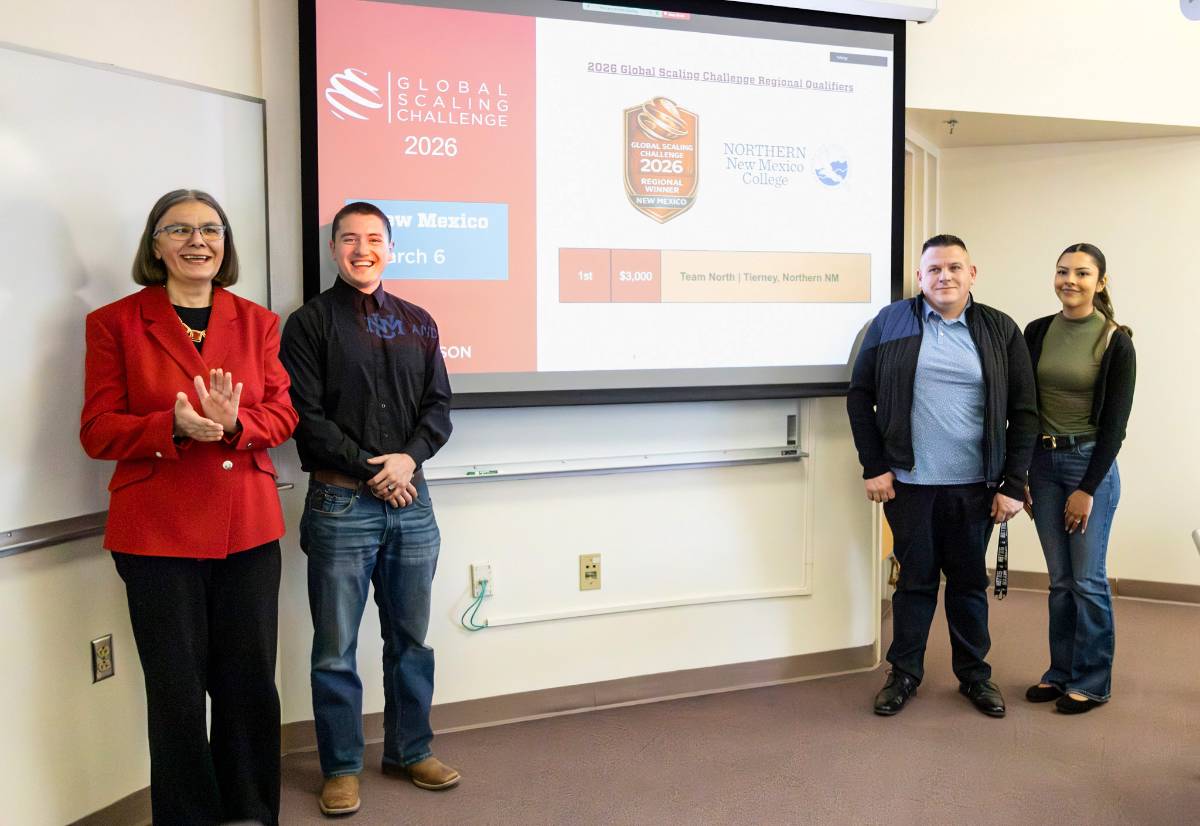
Northern New Mexico College (NNMC) earned 1st place in the New Mexico Regional Global Scaling Challenge, sponsored by the University of New Mexico Anderson School of Management on March 6, 2026. Team North – with the support of mentor Dr. Robert (Bob) Tierney – delivered a compelling presentation that impressed judges with its strategic thinking, analysis, teamwork and scaling recommendations for Mesa Quantum, a company pioneering quantum sensors that provide resilience against GPS disruptions.
The 2026 Challenge brought together 63 teams globally competing across four regional qualifiers: Americas, New Mexico, Asia & Oceania, and Europe & Africa. Unlike other case competitions, Global Scaling Challenge teams take on the role of growth strategists for real firms in a live setting, working with company executives and founders on current problems they face. Firms benefit from new perspectives on their current business challenges with innovative suggestions for scalable commercial success.
Student teams and their mentors received case materials and detailed data analysis on the company. They had two weeks to conduct their own research, analyze the firm and develop plans to help Mesa Quantum translate its breakthrough physics into scalable, manufacturable, revenue-generating products.
“I told them, you’ve got to think of yourself as a consultant to this company. This is a real company. This is not an academic case. They want answers,” said Tierney, NNMC assistant professor in Business Administration. “If you want to win, you got to take it seriously.”
Tierney worked with the Northern team for a month, helping them to translate the basic business skills they are studying into real world applications. Team members had to take the leap from academic classwork like accounting into answering questions such as how much investment or grant money would this company need to become commercially viable, how can they get that money and how should they budget it? Tierney also introduced them to fundamentals usually taught in MBA classes, such as how to measure the maturity of the product and how companies can cross the gap from startup funding and niche marketing sales to progressively larger markets.
“I can't tell them what to do. I can only guide them, because I want it to be a learning experience,” Tierney said. “I don't want it to be my ideas. It's the group's ideas. I just act as a guide rail.”
With those principles and Tierney’s guidance in mind, the team developed a plan for how to scale up the company. They suggested funding sources and industries that could benefit from Mesa Quantum’s technology: military aircraft, commercial aircraft, transatlantic and continental shipping, autonomous vehicles.
Tierney encouraged them to provide alternative options rather than a rigid proposal, so their suggestions included factors like parallel pathways for funding in case sources fell through.
“There's a very clean side of business, which is academia. You do this, this is a result,” Tierney said. “In the real world, it's not like that. It's very dirty. You have no idea what's going to happen tomorrow. It's your best guess. So make your best guess and go from there.”
One team member compared the Challenge to a capstone project that tested the skills the students have learned throughout their academic careers. They had to apply those academic skills to practical solutions for how a business can succeed when it runs into bottlenecks along its business life cycle, building a business model and constructing it all the way out. Instead of an academic scenario, the team had a snapshot of what reality looks like from an investor's perspective that they expanded into a tangible plan with financial feasibility.
Winning the New Mexico Regional Challenge advanced Team North to the Global Scaling Challenge Finals April 3, 2026, where they competed against 24 other teams representing 10 countries and 23 universities, all well ranked schools with highly regarded business programs. Unlike the regional competition, which was in person, the international competition was conducted via Zoom.
The case study for the finals was Applied Surface Engineering (ASE), an advanced engineering company whose breakthrough technology for surface textures can reduce drag up to 39 percent, translating into significant fuel savings, performance gains and emissions reductions. Teams were challenged to evaluate ASE’s business model and develop data-driven strategies to scale manufacturing partnerships, refine go-to-market approaches and prioritize high-value end markets across aerospace, automotive, defense and energy.
Although Team North did not place among the top 10 in the international competition, the students valued the experience.
“I did like the one in New Mexico better, because it's in person and it's just so much easier to articulate your thoughts in person,” said team member Gabriella Gonzales. “But international was really a great experience as well. It was definitely a more challenging case, and I liked that the companies weren't at the same level, so it gave us experience into looking at different markets and different funding opportunities.”
Another team member, Julian Baros, also found the Zoom presentation more challenging. He enjoyed seeing the presentations of the other teams.
“Many of those other students had a lot of bright ideas, and they flowed very well in their presentation. Maybe they've done a little bit more public speaking, so that's something I think I'll need to work on,” Baros said. “But it was fun. It was definitely cool to see everybody's different ideas.”
The students won $3,000 for first place in the New Mexico competition and $200 for their participation in the international competition, with the winnings split equally among them.
Team North was comprised of business and engineering students who brought real-world experience in addition to their studies at NNMC. This was the first time any of them had competed in this way, yet they held their own against teams of graduate students, including many who were experienced competitors.
Gabriella Gonzales is employed in a project management division at Los Alamos National Laboratory (LANL). She will be graduating this summer with a Bachelor of Business Administration in Project Management.
“I think it's a great opportunity for the companies because they get some fresh eyes looking at their service or product,” Gonzales said. “It was also a great opportunity for us because it gave us experience with a real company in a real market, experience that we wouldn't get in a typical classroom setting. Instead of just learning about it, we got to put our theories to the test and see what actual investors thought of it. It was really exciting to win and to know that we were on the right track for how they could scale up.”
Gonzales found herself using skills she had learned in her accounting, statistics and finance classes, as well as business models and market basics she learned in class with Tierney.
“It helped me to look at things that I wouldn't have really considered in class. All the classes I took were coming back to me, and I was remembering, oh, I learned about this in this module,” Gonzales said. “I wouldn't have expected it to be applied so closely, so impactfully. Finance wasn't my favorite thing. I'm not a math fan. But getting to see my degree put to work in a real business setting was pretty cool, and it helped me to be a little bit more interested in that aspect of things.”
Julian Baros is pursuing a Bachelor of Engineering in Electromechanical Engineering
Technology degree. He transferred to Northern after earning an associate degree from
Santa Fe Community College. He is employed at LANL doing weld repairs on pressure
vessels, cleanouts and assemblies.
“It was interesting to see all the aspects that go into the process and how they figure
out what they need to do to scale up a business,” Baros said. “I thought it went well,
but the Challenge was definitely a whole new learning curve.”
Baros’ studies in engineering helped him contribute ideas about industries the companies’ technologies could benefit, and which would have a better market value for their business plan.
The experience broadened his perspective on his work at LANL, giving him a greater understanding of the projects he is working on. He expects the research skills he learned to be useful in his studies and career goals. He enjoyed the opportunity to practice public speaking skills and the teamwork of brainstorming and developing a plan. It also sparked interest in possibly pursuing a master’s degree in project management or engineering management after learning more about the business aspects of technological development.
Eli Abeyta, a University of New Mexico student who was on one of the teams they competed against in regionals, joined Team North for the finals.
“The regional competition was honestly scary because it was my first one,” Abeyta said. “But when team North picked me up it was interesting not only to meet new people but to be going up against skilled minds that made me try my hardest.”
Tierney sees this year’s competition as the start of something much bigger.
“I'm hoping to use this as a propellant for the future,” Tierney said. “Eventually, my idea is to have an internal competition at Northern with five or six teams, then take the top two teams to the competition at UNM.”
This year’s participants support that idea.
“It was a really good experience, and I hope Northern continues to have business competitions or get involved in them, because I would have liked to do this throughout my years here,” Gonzales said. “It gives students opportunities to learn in a different way. It helped me get out of my comfort zone and learn about things that I would have never like learned about in a typical learning setting, because it's something you have to experience.”
Any students interested in participating in next year’s Global Scaling Challenge should
contact Robert Tierney at robert.tierney@nnmc.edu.
________________________________
The regional Global Scaling Challenge was made possible through the support of several
New Mexico partners. UNM Anderson School of Management and Corey A. Cooper | Cooper
& Co. served as Innovation Leaders and Expansion Partners included Real Time Solutions,
Inc., NewSpace Nexus, New Mexico MEP (Manufacturing Extension partnership), REDW Advisors
& CPAs, Walt Benson, District 4 Bernalillo County Commissioner and Espalier.ai.
________________________________
Photo from left: Dean Alina Chircu, UNM Anderson School of Business with Team North members Julian Baros, Jeff Klingbeil and Gabriella Gonzales.